
Oct 18, 2026 · 4,739 words
Earn High-Quality Backlinks for Local Businesses — 8 Ways
You run a local business, you’re busy, and you need more customers finding you in Google and in AI answers. You’ve heard “get backlinks,” but you don’t have…

You run a local business, you’re busy, and you need more customers finding you in Google and in AI answers. You’ve heard “get backlinks,” but you don’t have hours to waste on tactics that don’t move local rankings. This guide shows you how to get high-quality backlinks for a local business with low-cost, repeatable steps you can start this week.
We’ll keep it practical: specific examples for common niches, copy‑and‑paste outreach templates, and what to prioritize in your first 30, 60 and 90 days. You’ll also get a simple way to track outreach and decide which sites are worth your time.
Key Takeaways
- Start with low-cost “foundation” links in month one: local directories/citations, niche associations, and a simple partner page swap. Budget 2–4 hours.
- Highest local SEO value typically comes from geographically relevant pages: local news coverage, chambers/associations, sponsor pages, and partner/vendor sites.
- Create one linkable local asset per quarter (e.g., a neighborhood guide or original mini‑survey) and pitch it to chambers, bloggers and partners.
- Track every outreach in a simple sheet and watch for early signs: referral clicks and impressions in Google Search Console before rankings shift.
- Expect a realistic timeline: local backlinks usually influence visibility in 6–12 weeks; consistency beats one “big” link.
Who this guide is for and what to expect
This guide is for small, local service providers (plumbers, salons, clinics), shops and restaurants, as well as small SaaS/ecommerce with local footprints. It assumes you have under three hours per week and a small budget.
What to expect:
- Cost: mostly time; sponsorships or associations can run from free to a few hundred dollars annually.
- Time: 1–3 hours weekly to research, send outreach, and maintain profiles.
- Timeline: backlinks tend to influence local rankings and map pack visibility after a few update cycles—often 1–3 months after links go live. News links can get crawled fast; directory links may take longer.
- Quality over quantity: a handful of locally relevant links will usually beat dozens of generic, low‑quality ones.
How to get high-quality backlinks for a local business (short primer)
Local backlinks help Google judge three things:
- Relevance: Does this site belong to this topic and this place?
- Prominence: Do reputable local sources mention and link to you?
- Trust: Are you cited consistently across the web?
A quick note on link quantity vs quality: For local SEO, the best links are both topically and geographically relevant (e.g., your city’s chamber of commerce, a local news story about your service, or your industry association’s member directory). A dozen such links can outperform hundreds of low‑quality directory submissions.
Terms you’ll see once:
- NAP: Your Name, Address, Phone number. Keep them consistent across listings.
- Follow vs nofollow: “Follow” links pass authority; “nofollow” may still help discovery and trust, especially from strong local sites (like news or chambers).
Quick comparison: the 8 tactics at a glance
Here’s how the eight tactics stack up on time, difficulty, link quality, and budget.
| Tactic | Typical time to implement | Difficulty (1–5) | Likely link quality | Budget notes |
|---|---|---|---|---|
| 1) Local directories/citations | 2–4 hours initial; 1 hour/month upkeep | 2 | Low–medium; good for NAP consistency | Mostly free; some paid directories |
| 2) Local partnerships/co‑marketing | 3–6 hours to secure 1–3 partners | 3 | Medium–high; relevant/local | Usually free; time investment |
| 3) Sponsorships/community events | 2–5 hours prep and outreach | 2–3 | Medium–high from local orgs | $50–$500 typical; in‑kind often works |
| 4) Local PR/media pitching | 4–8 hours per story cycle | 4 | High (local news/blogs) | Free; time to pitch and prep |
| 5) Linkable local content | 6–12 hours per asset | 3–4 | Medium–high; scalable | Free–low; optional design costs |
| 6) Niche industry directories | 1–3 hours to join/submit | 2 | Medium; strong topical relevance | Free–$300/yr typical |
| 7) Testimonials/vendor links | 1–2 hours for 3–5 asks | 1–2 | Medium–high; high relevance | Free |
| 8) Reclamation/broken links | 2–3 hours/month ongoing | 2–3 | Medium; compounding over time | Free |
According to Straight North’s local link guidance, directories remain a foundation, while local events and partnerships drive higher‑value local mentions. SEMrush notes that local influencers can also contribute, but we’ll keep this guide focused on tactics you can do with low or no spend.
Tactic 1 — Local directories and citation sites
Local citations are listings on sites that show your NAP (Name, Address, Phone) and often link to your website. These are table‑stakes for local visibility.
What still matters:
- Major platforms with local visibility (e.g., mapping apps, review platforms in your country).
- City/regional directories (chambers of commerce, tourism, neighborhood associations).
- Niche directories (e.g., health provider directories, legal associations).
Avoid:
- Low‑quality aggregator sites that list thousands of businesses with thin content.
- Networks that require reciprocal links on your homepage.
Likely outcomes:
- Most links are low–medium authority but help Google confirm your NAP and service area.
- Some will be nofollow; still valuable for discovery and consistency (and customers actually use them).
Examples: who uses local directories
- Café: Prioritize your city’s food and beverage directories, local tourism pages, and “best of [city] cafés” roundups. Add great photos and menus.
- Plumber: Target state contractor boards, local chamber, home‑services directories, and neighborhood associations or HOA vendor lists.
- Dental practice: Health insurance provider directories, ADA component/affiliate listings, local parenting blogs’ directories, chamber/rotary.
Outreach / listing template for directories
Subject: Listing request for [Business Name], [City]
Variation A — Claim an unverified listing: Hi [Name/Team], I noticed a listing for [Business Name] at [URL] that isn’t verified. Could you help me claim it? Here’s our correct info:
- Name: [Exact Name]
- Address: [Exact Address]
- Phone: [Number]
- Website: [URL]
- Hours: [Hours] Happy to provide any verification you need. Thanks!
Variation B — Create a fresh listing: Hi [Name/Team], Could we add [Business Name] to your [city/industry] directory? Our details: [Same NAP block plus categories, short description, and a few photos attached or linked] Appreciate your help, and let me know if you need anything else.
Time, difficulty and expected results for directories
- Time: 2–4 hours upfront to audit and submit the top 10–15; 1 hour monthly to maintain.
- Difficulty: 2/5 (straightforward but detail‑oriented).
- Results: 10–20 listings in month one; link quality ranges low–medium but essential for local trust and consistency.
30-day starter checklist for directory work
Week 1:
- Audit existing citations and note inconsistencies.
- Standardize your NAP, hours, categories, short description, and photos.
Week 2:
- Claim unverified listings; fix wrong info.
- Submit to 5–8 high‑value directories (city, chamber, niche).
Week 3:
- Add photos, services, menus, and a short blurb (don’t stop at just NAP).
- Ask 3 recent customers for reviews on your top 1–2 platforms.
Week 4:
- Track approvals; note login details and renewal dates.
- Log your listings and status.
Note: As Yahoo Finance’s guide on local backlinks reminds us, listings are also customer acquisition channels—add strong images and descriptions, not just a link.
Tactic 2 — Local partnerships and co-marketing
Forge reciprocal, sensible relationships with nearby businesses. Aim for:
- A partner page on each site listing trusted local providers (with short blurbs and links).
- Co‑promotions (bundle offers, seasonal guides).
- Shared content (guest tips, checklists) that each partner hosts and links.
Examples of partnership ideas by niche
- Bridal shop + florist + photographer: “Trusted wedding partners in [City]” page on each site. Bundle discount for off‑season bookings.
- Mechanic + tow company: Joint “What to do after a breakdown in [City]” guide. Each lists the other as a recommended provider.
- Yoga studio + nutritionist: 4‑week wellness challenge landing page. Cross‑link from both blogs and a partner page.
Outreach templates for partnership asks
Casual intro: Subject: Quick idea for [City] customers
Hi [Name], I’m [Your Name] from [Business]. We serve the same [audience] in [City] and already refer people your way. Want to grab 15 minutes to swap a link on a simple “Trusted partners in [City]” page and discuss a small co‑promo? No pressure, low‑lift. If yes, I’ll send 2–3 ideas. Thanks!
Formal co‑marketing proposal: Subject: Co‑marketing page for [City] customers
Hi [Name], I’d like to propose a small co‑marketing asset:
- A “Trusted [service] partners in [City]” page on each of our sites
- 100–150 words + logo about each other
- One seasonal tip we each contribute If it sounds useful, I can draft copy and a mockup this week. Open to tweaks—goal is simple value for both audiences.
Time, difficulty and expected results for partnerships
- Time: 3–6 hours to research, outreach, and publish one partner swap.
- Difficulty: 3/5 (requires buy‑in).
- Results: 1–3 high‑relevance local links per month once you get a rhythm; links live on contextually relevant pages.
30-day starter checklist for partnership outreach
Week 1:
- List 10 complementary businesses (not competitors).
- Draft a 100‑word blurb and get your logo, brand colors, and a headshot ready.
Week 2:
- Send the casual intro to all 10; schedule 3 short calls.
Week 3:
- Publish at least one partner page swap.
- Draft a simple co‑promo (bundle or seasonal guide).
Week 4:
- Share the co‑promo on both sites and socials; ask partners to link from their footer “Partners” or “Community” pages.
Tactic 3 — Sponsorships and community events (including in-kind)
Local events often have sponsor pages listing logos and website links. You can support in cash or in‑kind (products, services, space, printing).
Sponsorship ideas and examples
- Youth sports teams or school clubs (uniforms, snacks, equipment).
- Charity 5Ks, neighborhood fairs, library events.
- In‑kind swaps: a café provides coffee for a volunteer day; a print shop donates flyers; a plumber sponsors safety demos.
How to pitch in‑kind:
- Offer a dollar value and what you cover (e.g., “We’ll provide $200 worth of coffee and pastries for the volunteer kickoff”).
- Ask for logo + link on the sponsor page and one social post thank‑you.
Sponsorship outreach template and negotiation notes
Subject: In‑kind sponsorship for [Event] in [City]
Hi [Organizer Name], I’m [Your Name] from [Business]. We’d love to support [Event] with an in‑kind contribution:
- [What you’ll provide] (est. value $[amount])
- Delivery/setup on [date/time] In return, could we be listed on your sponsor page with our logo and a link to [URL]? Happy to send assets today. Thanks for all you do.
Negotiation notes:
- Ask about sponsor page timing and whether it’s on the main event site (better) or a third‑party platform.
- Confirm if the listing stays up after the event.
Time, difficulty and expected results for sponsorships
- Time: 2–5 hours to identify events, pitch, and provide assets.
- Difficulty: 2–3/5 (organizers are usually receptive).
- Results: 1–2 strong local links per event; some sites are highly trusted locally (schools, municipalities, community orgs).
30-day starter checklist for sponsorships
Week 1:
- Search “[city] sponsors,” “[city] 5k sponsors,” and event calendars for the next 3 months.
- Shortlist 5 targets that have sponsor pages.
Week 2:
- Prepare a sponsor packet: logo, 100‑word blurb, link URL, social handles.
- Send 5 pitches (cash or in‑kind).
Week 3:
- Confirm link placement and logo specs.
- Deliver your contribution; ask for a social post credit.
Week 4:
- Check that sponsor links are live; note if they persist after the event.
Tip: Marketing Illumination suggests using search operators like inurl:sponsors [your city] to find opportunities.
Tactic 4 — Local PR and media pitching
Local media still link—and they’re among the most authoritative local sources. Good stories beat company news.
Story angles that work for local press
- Local data: “The 5 most common [issue] calls we got in [City] this summer” with tips to prevent them.
- Human-interest: A standout customer/community story with permission.
- Charity tie-ins: A local giving day, volunteer work, or an in‑kind project.
- Seasonal tips: Short, timely checklists journalists can quote.
Local media pitch templates
Data/story pitch: Subject: Local [topic] data for [City] + practical tips
Hi [Journalist], I run [Business] in [City]. We analyzed [simple, privacy‑safe data or survey] and found [1–2 local insights]. If helpful, I can share the full breakdown and 3 practical tips [City] residents can use this [season]. Happy to be a source on deadline. Here’s a 2‑sentence bio and headshot link if needed.
Expert commentary offer: Subject: Local source for [beat]: fast quotes + timely tips
Hi [Name], If you ever need quick quotes on [topic] in [City], I’m glad to help. I can provide 2–3 actionable tips or a short explainer within hours and have local examples. Here are a few angles I can speak to: [3 bullets]. Thanks for considering; I know deadlines are tight.
Time, difficulty and expected results for local PR
- Time: 4–8 hours per story cycle (angle, pitch, follow‑up, assets).
- Difficulty: 4/5 (hit rates vary; persistence matters).
- Results: One placement can deliver a high‑authority local link and brand lift. Local blogs and community publications are also valuable.
Note: Guest contributions on local blogs can also work, as Blurbpoint points out—write something audience‑first, not self‑promotional.
30-day starter checklist for PR outreach
Week 1:
- Draft two short angles: one data, one seasonal tips.
- Gather a bio, headshot, and 2–3 customer quotes (with permission).
Week 2:
- Identify 10 local journalists/blogs covering your beat.
- Send pitches; note deadlines and preferences.
Week 3:
- Follow up once (3–5 business days later) with a new nugget or tighter subject line.
Week 4:
- If no bites, spin your angle into a blog post on your site; then re‑pitch as “we published local data” to community blogs/chambers.
Tactic 5 — Create linkable local content (neighborhood guides, maps, local data)
Make one small but useful “link magnet” each quarter and pitch it locally.
High-value local content formats and mini-templates
- Hyperlocal guide: “The practical [Neighborhood] guide for [audience]” Structure: 5–7 places with maps, hours, accessibility/parking, and best‑time‑to‑go notes. Keep it practical and updated.
- “Best of” list curated by expertise: “7 kid‑friendly [service/places] in [City]: criteria we used and what to expect.” State clear criteria; invite suggestions.
- Original local data/survey: Run a 3–5 question poll of your customers (privacy‑safe). Share findings in simple charts and 3 actionable takeaways.
- Interactive map/checklist: A Google Map or downloadable checklist for a niche need (e.g., “24‑hour resources in [City]” or “Accessible trails under 2 miles”).
Outreach template to promote local content
Quick share: Subject: New [City] resource: [Title]
Hi [Name], We just published a practical [guide/map/data] for [audience] in [City]: [URL]. If it’s useful, feel free to include it on your resources page. Happy to add your [resource] in our next update too.
Chamber/association angle: Subject: Resource for your members/visitors in [City]
Hi [Name], This [guide/map/data] helps [audience] navigate [topic] in [City]. May we suggest it for your [resources/visitor] page? We’ll keep it updated quarterly and can add your logo as a supporter.
Time, difficulty and expected results for local content
- Time: 6–12 hours to create and publish a solid asset.
- Difficulty: 3–4/5 (planning + formatting).
- Results: 2–10 links over a few months if pitched well to chambers, blogs, and partners. Improves topical authority and earns citations.
30-day starter checklist for producing linkable content
Week 1:
- Pick a format and outline (focus on one neighborhood/audience).
- Gather data, photos, and map pins.
Week 2:
- Draft the content; add practical details (hours, parking, pricing notes).
Week 3:
- Publish with a clear title, last‑updated date, and simple graphics.
Week 4:
- Pitch to 15 local targets (chamber, community blogs, partners, schools). Share on social and in customer emails.
Tactic 6 — Niche industry directories and associations
Trade associations and profession‑specific directories carry strong topical relevance—often better than generic directories.
Examples by profession or product niche
- Legal: State bar member directory; local bar associations; specialty groups (e.g., family law associations).
- Trades: State contractor license board listings; manufacturer “find a pro” directories; energy‑efficiency program partner lists.
- Health/beauty: Professional associations; product brand “authorized retailer” pages; local wellness coalitions.
Outreach template for association listings and partnerships
Subject: Membership/listing inquiry for [Association]
Hi [Coordinator], I’m a [profession] in [City] and would like to join/confirm our listing on [Association]’s member directory. Could you advise next steps and how to include our website URL in the profile? Happy to provide dues/payment and a 100‑word bio.
Bonus: When you join or renew, offer a short testimonial and ask if they maintain a “member stories” page with a link.
Time, difficulty and expected results for niche directories
- Time: 1–3 hours to find, join, and submit listings.
- Difficulty: 2/5.
- Results: 3–5 strong, topically relevant links in your first quarter; often persist year‑to‑year.
30-day starter checklist for industry directory outreach
Week 1:
- Identify 5 associations/directories relevant to your niche and city/state.
Week 2:
- Prepare your profile copy, headshot, certifications, and NAP.
Week 3:
- Submit/join; pay dues if applicable.
Week 4:
- Confirm your listing goes live with a website link; note renewal dates.
Tactic 7 — Testimonials, supplier & vendor links
Suppliers love customer stories. Offer a sincere testimonial and ask to be featured on their “customers,” “success stories,” or “where to buy” pages.
Examples of testimonial opportunities
- Café: Your local roaster’s customer page; espresso machine brand’s “in the wild” gallery.
- Salon: Scissors/chair manufacturers, salon software vendors.
- Plumber: Specialized parts distributors, water heater brands’ “find a pro” page.
Testimonial outreach/template
Subject: Short testimonial + permission to use
Hi [Partner], We’ve had great results with [product/service] over [timeframe]. Here’s a quick testimonial you have our permission to use: “[2–3 sentences with a specific benefit].” If you feature customer stories, we’d be honored to be included with our logo and a link to [URL]. Happy to provide a photo or details.
Time, difficulty and expected results for testimonial links
- Time: 10–20 minutes per testimonial; 1–2 hours to send five.
- Difficulty: 1–2/5.
- Results: Usually one high‑relevance link per partner; some on authoritative brand domains.
30-day starter checklist for testimonial outreach
- List 5 suppliers/partners you truly recommend.
- Draft 2–3 sentence testimonials with specific outcomes.
- Send, follow up once, provide logos/photos.
- Track placements.
Tactic 8 — Reclamation and broken-link outreach
Two recurring wins:
- Reclamation: Ask sites to add a link where they already mentioned your business but didn’t link.
- Broken link replacement: Offer your page to replace a dead link on a relevant local resource page.
Where to look for unlinked mentions and broken links
- Use Google search operators: “Business Name” -site:yourdomain.com; or “[Business Name] [City]”.
- Set up alerts for your brand and owner’s name.
- Find broken links on local resource pages, school/club pages, old event pages, or “best of” lists that haven’t been updated.
Tools: You can spot broken links with common browser extensions or free checkers; you don’t need paid tools to start.
Reclamation and broken-link outreach templates
Unlinked mention: Subject: Quick request to add our link
Hi [Name], Thanks for mentioning [Business] here: [URL]. Would you mind linking our name to [Your URL] so readers can reach us directly? Appreciate it!
Broken link replacement: Subject: Broken link on your [page]
Hi [Name], I noticed a broken link on this page: [URL] → [Anchor text]. We published a current resource that covers the same need: [Your URL]. If it helps your readers, feel free to swap it in. Happy to flag any other broken links I spot.
Time, difficulty and expected results for reclamation work
- Time: 10–15 minutes per outreach; 2–3 hours monthly for a batch.
- Difficulty: 2–3/5.
- Results: Modest hit rate, but high ROI. Over time, you’ll convert a handful of quality mentions and resource pages.
30-day starter checklist for reclamation and broken-link hunting
- Week 1: Run brand searches; list 10 mentions without links.
- Week 2: Send 10 reclamation emails.
- Week 3: Identify 10 local resource pages; check for broken links.
- Week 4: Send 10 broken link replacement emails; follow up once.
Which link sources carry the most local SEO value (and why)
Prioritize:
- Local authority: City news outlets, chambers, municipal or school pages, and well‑known community orgs signal strong geographic trust.
- Topical authority: Industry associations, manufacturer directories, niche blogs indicate your subject expertise.
- Relevance + context: Links on pages about your city or service outperform random sitewide footer links on unrelated domains.
In short, when deciding how to get high-quality backlinks for a local business, match both your topic and your geography. A single chamber listing plus one local news story can outweigh dozens of generic submissions.
How to prioritize tactics when time and budget are limited
If you have under 3 hours/week:
- Month 1 priority: Directories/citations + niche associations + one partner page swap.
- Month 2: Sponsorship (in‑kind if possible) + testimonial links + start a linkable guide.
- Month 3: Local PR pitch using your published guide or data + ongoing reclamation.
Decision matrix:
- Fastest wins: Directories, testimonials, reclamation.
- Highest potential authority: Local PR, chambers/associations, sponsor pages.
- Most scalable over time: Linkable content + partnerships.
Tracking outreach and measuring success
Keep it simple with one spreadsheet or a basic CRM. The goal is consistent follow‑up and visibility into what’s working.
A simple outreach spreadsheet template (columns)
- Prospect Name
- Website
- Page/URL to target
- Contact Name
- Contact Email/DM
- Tactic (directory, partner, PR, etc.)
- Date Sent
- Template Used
- Status (sent, replied, live, declined)
- Follow‑Up Date
- Notes (requirements, cost, next steps)
Use Google Sheets so multiple team members can update concurrently. Color‑code by tactic or status.
KPIs and how to judge whether links are moving the needle
Short term (1–4 weeks after links go live):
- New referring domains
- Referral visits from those links
- Indexed pages and crawl frequency
Medium term (4–12 weeks):
- Impressions and queries in Google Search Console for local terms
- Map pack visibility and local rankings for “[service] + [city]”
- Branded search volume and direct traffic trends
If nothing moves after 8–12 weeks:
- Reassess link quality and relevance.
- Improve on‑page SEO (title, H1, internal links, service pages).
- Publish one stronger local asset and pitch higher‑authority targets.
Quality checklist: how to vet a link prospect
Before you spend time, check:
- Relevance: Is the site local to your city/region or directly about your industry?
- Real audience: Does it show recent posts, sensible categories, and actual engagement?
- Technical basics: Not “noindex,” not behind paywalls, and links aren’t hidden behind JavaScript that search engines likely ignore.
- Link placement: A contextual link on a relevant page beats a generic footer or a page listing thousands of unrelated businesses.
- Reputation: Avoid obvious link farms, spun content, or sites offering paid links in bulk.
Directory and citation best practices: which to use and which to avoid
Use:
- Your city’s chamber of commerce and reputable local directories.
- Industry and professional directories (licensing boards, associations).
- Platforms customers actually browse in your region.
Avoid:
- Thin aggregator networks with duplicate content.
- Any site that requires you to place their badge on your homepage.
Standardize in your profile:
- Exact NAP, hours, categories/services, short description.
- High‑quality images and, if relevant, menus or price ranges.
- Consistent URL format (decide on https://www vs non‑www and stick to it).
As Yahoo Finance’s piece on local backlinks notes, directories serve real customers too—make your listings compelling, not just complete.
How long until backlinks affect local rankings (realistic timeline)
- Crawling and indexing: Days to a few weeks, depending on the site.
- Early signals: Referral traffic and impressions often rise within 2–6 weeks.
- Ranking impact: 6–12 weeks is common once you’ve earned several relevant links and improved citations.
What speeds results:
- Links from sites crawled frequently (news, chambers).
- Consistent on‑page basics (clear service pages, local keywords, internal links).
- Multiple relevant links over several weeks, not a single spike.
Consistency matters more than chasing one blockbuster. A steady cadence of locally relevant links is how to get high-quality backlinks for a local business without burning out.
30/60/90 day action plan you can follow
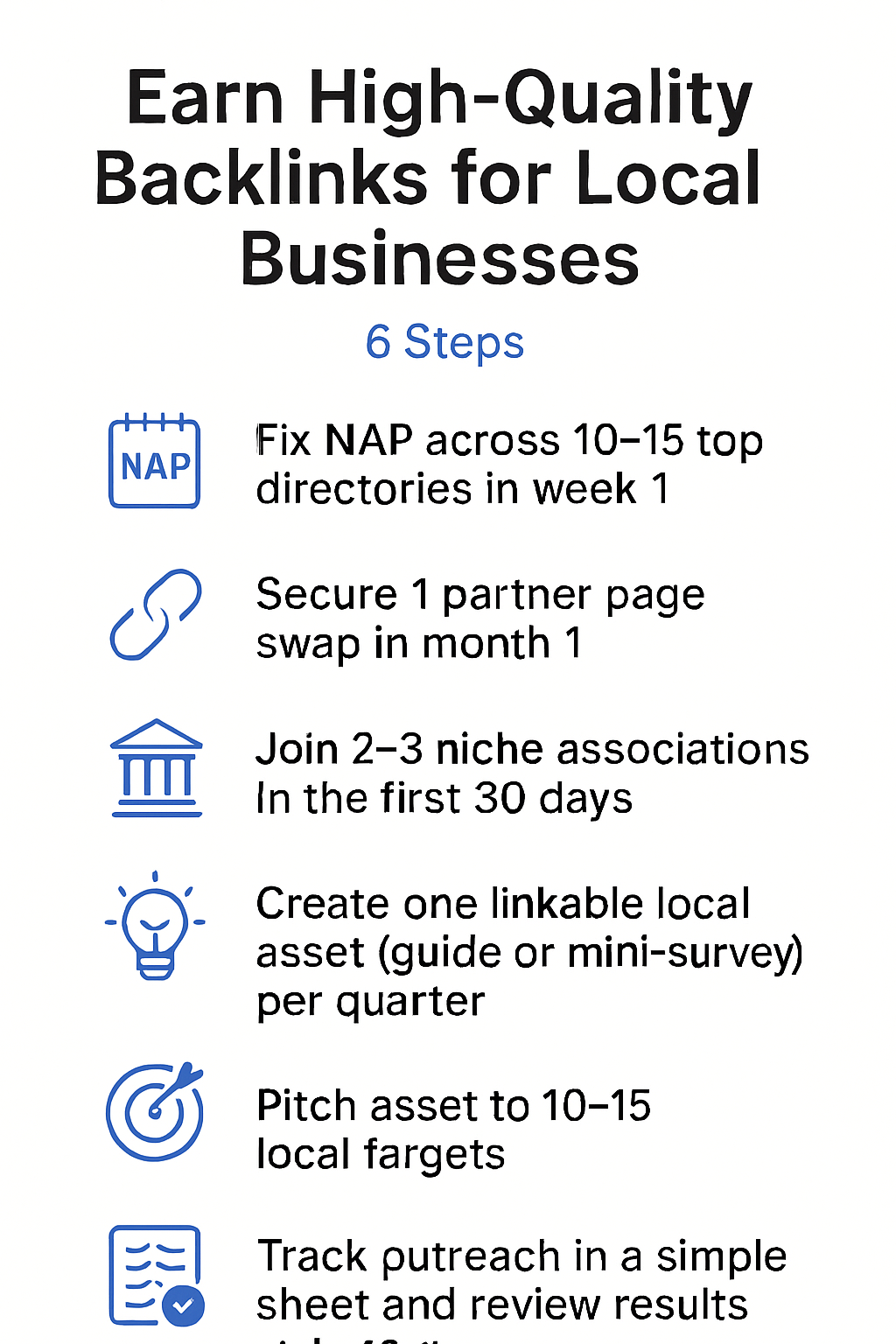
Days 1–30:
- Audit and fix NAP across top directories (10–15).
- Join 2–3 niche associations or manufacturer directories.
- Secure one partner page swap.
- Send 5 testimonial offers to suppliers.
Days 31–60:
- Build one linkable local asset (guide/map/data).
- Pitch it to 15 local targets (chamber, blogs, partners).
- Land one sponsorship (preferably in‑kind).
- Start monthly reclamation: 10 unlinked mentions + 10 broken link opportunities.
Days 61–90:
- Pitch one local PR angle (data or seasonal tips).
- Add a second partner swap and refresh your first asset.
- Review KPIs in GSC and analytics; tighten targeting based on what referred traffic and responses show.
By day 90, you should have a small set of solid local links, consistent citations, and a repeatable outreach rhythm.
If you want help publishing linkable content consistently
If you prefer to outsource the “always be publishing” part, one option is Competitaurus. It researches your website, plans 30 days of content, and writes one expert SEO article per day with images, plus topic‑matched backlinks and auto‑publishing to popular CMS platforms. See how SEO articles run on autopilot at https://www.competitaurus.com/, how its topic‑matched backlink approach works at https://www.competitaurus.com/get-backlinks, and browse example articles at https://www.competitaurus.com/examples. No guarantees on rankings—just a consistent, expert content engine you can review during a free trial.
Final checklist and next steps
Today:
- Standardize your NAP and fix 3 priority directory listings.
- Draft one partnership email and one testimonial email; send both.
- Outline a simple neighborhood/resource guide.
This week:
- Pitch one in‑kind sponsorship and prepare a sponsor asset pack.
- Build your outreach sheet and log every contact.
- Identify 10 reclamation targets and send requests.
This month:
- Publish your local asset and pitch 15 local sites.
- Join 1–2 niche associations.
- Review early KPIs and refine your target list.
Repeat these steps and you’ll build exactly what matters: a steady stream of locally relevant mentions and links. That’s the practical path for how to get high-quality backlinks for a local business—and for turning local visibility into real customers.
Frequently Asked Questions
Are directory and citation links still worth the effort for local SEO?
Yes. Directories and citations remain foundational because they confirm your NAP and service area to search engines and customers. Treat them as customer-facing assets—add photos, a good description and accurate hours—rather than ticking boxes on low‑quality aggregator sites (see SEMrush and Yahoo Finance guidance).
How long will it take for new backlinks to affect my local search rankings?
You can see referral traffic and impressions within 2–6 weeks, while ranking changes commonly appear in 6–12 weeks after links are indexed. Links from frequently‑crawled sites (local news, chambers) tend to be discovered faster; consistent link gains over several weeks work better than a single spike.
Should I pay for sponsorships or ask for in-kind sponsorships instead?
Both work; choose what fits your budget. In‑kind sponsorships (products, space, services) often secure sponsor page links for a low cash outlay, while paid sponsorships may give more prominent placement. Always confirm the sponsor page URL and whether the listing remains live after the event before committing.
What should I do first if I only have 2–3 hours a week?
Month 1: audit and standardize your NAP, claim or fix 10–15 high‑value directory listings, join 1–2 niche associations, and secure one partner page swap. Those activities deliver quick coverage and set the foundation for higher‑value outreach later.
Can I ask suppliers or partners for a link without sounding salesy?
Yes—offer a genuine testimonial or case note and provide ready‑to‑use assets (2–3 sentence quote, logo, photo). Frame it as appreciation (“we’d be honored to be featured”) and keep the ask simple: permission to include your link with the testimonial.
How many links do local businesses typically need to see a difference?
There’s no fixed number; a handful of highly relevant, local links (chamber, local media, partner/vendor pages) can outperform dozens of generic listings. Aim for a steady cadence—several meaningful links over 6–12 weeks—rather than chasing volume.
Are nofollow links completely useless for local SEO?
No. While nofollow links don’t pass traditional link equity, they help discovery, drive referral traffic and signal local relevance—especially when they come from authoritative local sites like news outlets or chambers. Use them as part of a broader, relevance‑focused strategy.
What are the biggest red flags that make a link prospect not worth pursuing?
Avoid sites with obvious link‑farm behavior, thin or scraped content, pay‑to‑link networks that require reciprocal badges, pages listing thousands of unrelated businesses, or pages that are noindex/behind paywalls. Also skip prospects that can’t place a contextual link in relevant content.